About Photizo
Buy Your Photizo Now. ONLY R3 800
Buy Your Photizo Now. ONLY R3 800
Photon Therapy Systems was founded in 2005, and is a South African company focused on providing leading edge light therapy solutions to healthcare professionals and end users.
Photizo® Light Therapy is the product of revolutionary thinking and was born out of a need for non-invasive, natural wound-care in diabetic patients. However, numerous studies found that light therapy is hugely successful in treating many other conditions which result from compromised cell functioning. This led the team to expand its product range to cover rehabilitation therapy, beauty therapy, clinical care and treatment of animals.
With light therapy being traditionally only available to healthcare professionals, The Photizo® team saw a need to develop an affordable unit so everyone could benefit from the healing power of Photizo® Light Therapy. This dream became a reality in 2012 when the Home Care range was launched. These are affordable, portable handheld units, which are safe and easy to use, making them accessible to the whole family.
The company has been exporting the Photizo® models for animal use to the overseas markets since 2012 with great success. Currently these can be obtained through the distributor network in Europe, USA and New Zealand, and expansion into other potential overseas markets is continuously under consideration.
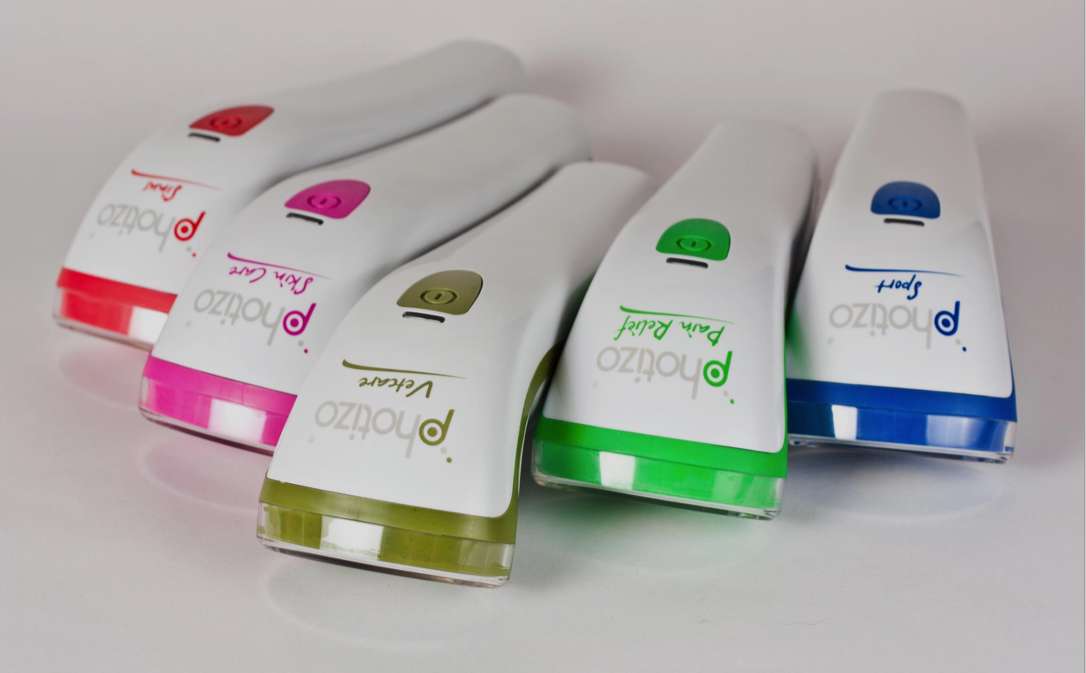


Light Emitting Diodes (LED’s) have been around for a long time, but have only been introduced as a legitimate therapy option in recent years. LED’s are similar to lasers in that as they can emit the same light but differ in the way that the light energy is delivered. Lasers are focused-beam single-wavelength light emitters that can be intense enough (a ‘hot’ laser) to burn/cut tissue or ‘cold’ enough to only have light therapy effects. LED’s do not deliver enough power to damage the tissue, but they do deliver enough energy to promote natural self-healing and pain relief. With a low peak power output, the LED’s provide a much gentler delivery of the same healing wavelengths of light, as does the laser but without the same risk of accidental eye damage that lasers do.
LED’s are merely convenient devices for producing light at specific wavelengths, and several studies established that it is the light itself at specific wavelengths that is therapeutic in nature. All biological systems have a unique absorption spectrum that determines what wavelengths of radiation will be absorbed to produce a given therapeutic effect. The visible red and invisible infrared portions of the spectrum have been shown to have highly absorbent and unique therapeutic effects in living tissues.
LED’s also allow the light beam to spread out instead of being a pinpoint light beam. The wide-angle diffusion of the LED confers upon it greater ease of application, since light emissions are thereby able to penetrate a broader surface area, and this results in faster treatment time for a given area than laser.

Visible Red Light: Light that lie within the visible spectrum, from 400nm (violet) to 700nm (red). At a wavelength of 660 nanometers (nm – 1 nanometer is equal to one billionth of a meter), penetrates tissue to a depth of about 8-10 mm (about 3/8″). It is very beneficial in treating problems close to the surface such as wounds, cuts, scars, trigger points and acupuncture points, and is particularly effective in treating infections.
Infrared Light: Light in the invisible spectrum (below red), from 700nm to 2,000nm. Infrared Ray is not visible to the eye; it penetrates to a depth of about 30-40 mm (1.2″ to 1.4″), which makes it more effective for bones, joints, deep muscles, bursa, etc. Although both red and infrared wavelengths penetrate to different depths and affect tissues differently, their therapeutic effects are similar.
Does red light therapy work?
How does red light therapy work?
For what can I use red light therapy?
How long does it take for red light therapy to work?
- For the “healthy glow” of a photofacial, you’ll see a difference right away.
- When used in conjunction with infrared light for pain relief, results can arrive in under 20 minutes.
- As a skin healing therapy, some improvements should be noticed in as little as 24 hours from the first treatment. If the wound is quite small and superficial, a healthy person should see quite a dramatic improvement in a short period of time.
- Healing a longstanding open wound that has been non-healing, such as in the case of diabetic wounds, the process does take longer, but there should be a gradual, noticeable differencethat is certainly better than what was occurring without the light therapy.
- Acne scars and scars from other types of injuries can start being visibly improved in as little as two weeks, and should gradually fade over time with continued use.
What is the difference between red and near infrared light therapy?
- Red light is visible and near infrared light is invisible.
- Near infrared light penetrates into the body deeper than red light.
What is the difference between red light and LED light?
Is Red Light Therapy FDA Approved?
The therapy isn’t what gets the approval, it’s the device that must go through the FDA approval process. Each device much prove that it works and is safe to use.
Red light therapy devices have been FDA approved for a growing list of things including acne treatment, anti-aging, hair-loss and regrowth, pain relief, fat loss, etc., so the therapy has been proven to be save and effective over and over again.
So yes, red light therapy has been FDA approved. But not all red light therapy devices have FDA approval.
If FDA approval is important to you, ask for proof that the device you are thinking of buying is actually FDA approved, or FDA cleared.
Does red light therapy work through clothes, bandages or dressings?
Does near infrared light therapy work through clothes, bandages or dressings?
How often do I need to use red light therapy?
Can I use it more than once per day?
Do I need to continue to use the light as much when I start seeing results?
Once my skin problems have been resolved, do I stop using the light?
Is there such thing as getting too much red light therapy?
Does red light therapy work for everybody?
As the results usually occur gradually, the best way to monitor the difference is by taking weekly or monthly pictures with a good quality camera, at the same time of the day, in the same lighting. Looking in the mirror is not always the best gauge of progress as it is much more difficult to notice subtle, gradual improvements over time.
Can red light therapy be combined with treatment lights of other colors?
Can I use more than one color of light therapy simultaneously?
Can I still use my regular skin care products while I’m using red light therapy?
Can I use my existing prescription products?
Is red light therapy safe to use on sensitive skin?
Can I use red light therapy after botox injections?
Can I use red light therapy on tattooed skin?
Do I have to wear the protective goggles if I am not facing the light?
Is there UV in red or near infrared light therapy devices?
Can red light therapy cause skin cancer?
Can I get a sunburn from red light therapy?
That said, red light therapy could be very helpful in healing a sunburn.